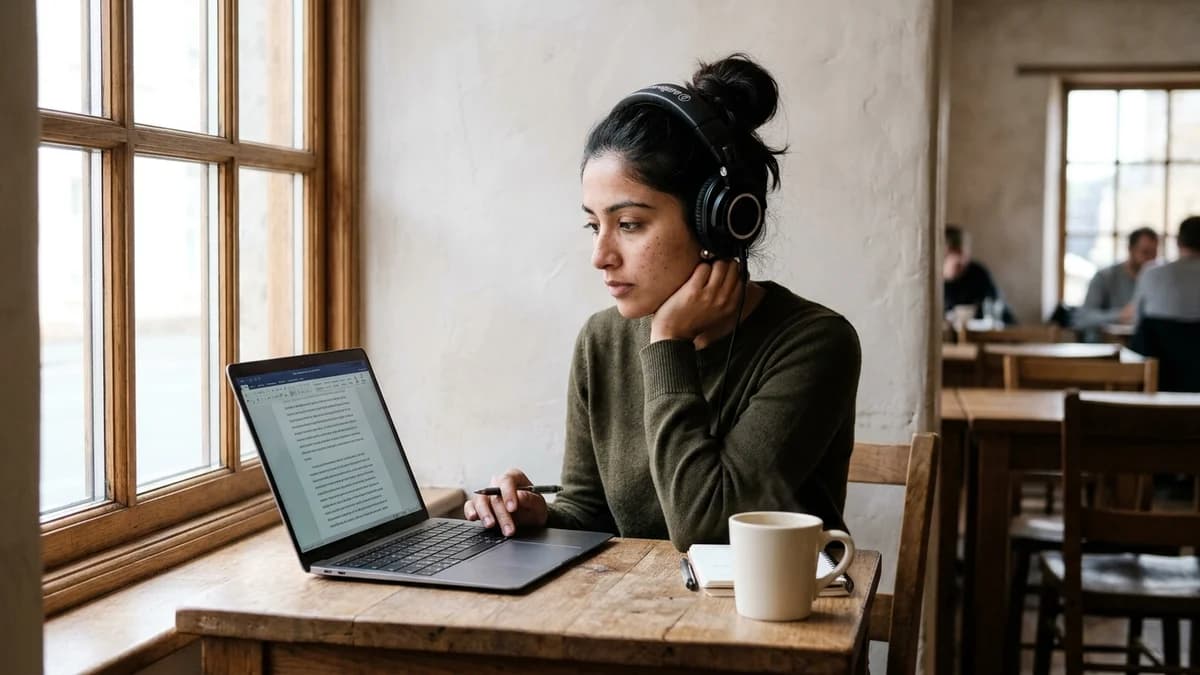
To create an AI audiobook in your own voice, clone your vocal timbre from a dry studio reference, generate chapter audio in modular sections, and master files to match distributor standards. By checking current ACX audio guidelines and generating clean 192 kbps MP3 files, authors can narrate their own books without spending weeks in a sound booth.
Key Takeaways
- A 60,000-word book requires ~380,000 characters (~6 audio hours), costing under $3 in credits on the $7/mo Storyteller plan.
- Wide distribution platforms like Google Play Books, Kobo, and Spotify accept synthetic narration with proper disclosure tags.
- Batch manuscripts into individual chapter files (3,000–5,000 characters) to streamline mastering and proof-listening.
- Mastering compliance: check distributor audio requirements for target loudness, peak headroom, background noise, and file formatting.
The traditional audiobook barrier: why authors struggle to narrate
For independent authors, publishing an audiobook version is one of the highest-converting decisions in modern book marketing. Audiobooks represent a major growth segment of the publishing industry. They generate millions in annual royalties. Yet, over 70% of indie titles never receive an audio edition.
If you'd rather narrate your book without weeks in a booth, you can generate long-form voiceovers in your own voice from a short sample, one chapter at a time.
The obstacle is financial and physical:
- Commercial Narrator Fees: Hiring professional human narrators involves significant upfront talent invoices and production costs for a full-length book.
- Vocal Strain & Booking Friction: Reading aloud for 6 hours a day causes severe vocal hoarseness, throat phlegm, and acoustic fatigue. Physical strain mounts quickly. Most authors abandon physical self-narration after two chapters.
- Studio Equipment Costs: Constructing an acoustically dead booth and buying a broadcast microphone interface easily exceeds $1,500.
Author Brand Equity
Readers form a deep personal bond when they hear the actual author narrate their own book. Cloning your personal voice preserves that intimate author-reader connection across your entire back-catalog. You avoid spending hundreds of hours speaking into a microphone.
Platform distribution: Audible ACX versus wide self-publishing for synthetic audiobooks
Navigating platform distribution policies is essential when self-publishing an author-narrated synthetic production. Retailers maintain distinct distribution standards:
For complete foundation details and architectural walkthroughs, explore our comprehensive guide to AI voice cloning.
Consult the official guidelines from the Audible ACX Audio Submission Requirements and the Spotify for Authors Platform when evaluating distribution channels:
| Distribution Platform | AI Narration Policy | Royalty Structure | Submission Protocol |
|---|---|---|---|
| Google Play Books | Has its own auto-narration program; check Google's current rules before uploading AI-narrated audio | 70% author royalty | Upload WAV/MP3 files directly or generate via partner feeds |
| Spotify / Findaway Voices | Permitted with required synthetic media disclosure | Varies by distributor (wide pool) | Submit mastered 192k MP3 files with synthetic metadata tag |
| Kobo Writing Life | Permitted on non-exclusive catalogue | 35% – 45% list price | Direct author dashboard upload |
| Audible ACX | Requires human voice for standard exclusive program | 20% – 40% exclusive | ACX requires live human studio recording verification |
Audiobook mastering standards: loudness, peaks, and noise floor
Professional audiobooks must satisfy rigorous acoustic benchmarks. This standard applies whether distributing through Spotify, Kobo, or direct author web stores. Before mastering your chapter exports, check ACX's current audio requirements to verify the latest submission specifications for volume, peak limits, and background noise thresholds.
- Average Volume: Maintain consistent volume across every chapter so listeners never have to adjust playback levels.
- Safe Headroom: Leave clean headroom below maximum digital limits to prevent distortion.
- File Delivery: Master chapters to constant-bitrate MP3 files with clean head and tail room tone.
The 5-stage chapter batching production pipeline
Do not attempt to synthesize a 300-page book in one continuous block. Follow this five-stage chapter production sequence:
- Manuscript Cleanup: Spell out acronyms and numbers phonetically (e.g., "Chapter Four", "forty-two").
- Segment by Chapter: Divide text into individual chapter blocks of 3,000 to 5,000 words.
- Batch Synthesis: Generate each chapter in Loup Studio using your custom cloned author voice and download clean WAV files.
- Proof-Listen: Check each chapter with headphones. Use phonetic respelling for any unusual names that need adjustment.
- Master and Export: Normalize loudness across chapters and render CBR MP3 files for distribution.
Spelling Numbers Phonetically
Always write out numbers phonetically in your book manuscript (e.g., write 'nineteen eighty-four' instead of '1984' or 'forty-two thousand' instead of '42,000'). This supports natural reading cadence.
Auditioning personal clone fidelity against microphone audio
Audition how Loup Studio voice cloning captures natural vocal resonance on narrative literature compared to an original condenser microphone take:
Audio Audition Comparison
Credit math and publishing economics for authors
Loup Studio meters audio by text characters: 1 character equals 1 credit. At our baseline rate of 1,083 characters per minute of audio (~65,000 characters per hour), budgeting book production is completely predictable:
- Short Novella or Guide (30,000 words): Approximately 190,000 characters (~3 audio hours), easily completed in an afternoon.
- Standard Non-Fiction Book (60,000 words): Approximately 380,000 characters (~6 audio hours), consuming less than 40% of a monthly Storyteller subscription.
- Epic Fiction or Memoir (100,000 words): Approximately 650,000 characters (~10 audio hours), fully covered by the 1,000,000 credit Storyteller tier without overage fees.
On the $7/mo Storyteller plan (1,000,000 credits), an author publishing an 80,000-word novel consumes roughly 520,000 credits. The entire book generation costs only $7—less than the price of a single cup of coffee at a high-end recording studio.
Distributor aggregators: using Findaway Voices and Draft2Digital for wide reach
Rather than attempting to open individual publisher accounts with fifty separate international book retailers, independent authors rely on digital distributors like Findaway Voices (by Spotify) and Draft2Digital Audio to distribute mastered audio files to over 40 global storefronts, reaching key channels including:
- Spotify Audiobooks: Reach premium streaming subscribers across the US, UK, Canada, and Australia. These listeners receive monthly audiobook listening hours in their subscriptions.
- Library Platforms (OverDrive / Libby, Hoopla): Public libraries purchase digital audio licenses at premium institutional prices (often $30 to $65 per license). This creates reliable recurring royalties for backlist titles.
- International Retailers (Kobo, Storytel, BookBeat): Popular subscription platforms across Europe and Scandinavia where English-language non-fiction audio titles command strong listening demand.
When uploading synthetic voice audiobooks through aggregators, always check the metadata tag indicating AI-assisted narration. This ensures automated compliance across partner stores. It also protects your author profile from retailer audits.
Always check the synthetic media or AI-narration checkbox when uploading via Findaway Voices or Draft2Digital. This transparent disclosure helps you avoid rejected uploads on Apple, Spotify, and Kobo.
Producing the 5-minute retail sample that drives book sales
Every major audiobook store requires a standalone 1-to-5-minute retail audio sample. This preview is the single most critical marketing asset of your audiobook publication—it is the audio equivalent of your book cover and back-cover blurb.
Follow these guidelines when generating your retail preview track:
- Skip the Copyright Page: Never waste your 5-minute sample reading legal disclaimers, publisher addresses, or the table of contents.
- Hook with Core Narrative Conflict: Start directly at the most compelling scene in Chapter 1 or the central thesis question of your introduction.
- End on a High-Stakes Question: Cut the retail sample right as a major revelation is introduced, prompting the listener to purchase the full book to hear the answer.
Audiobook metadata, ID3 tagging, and chapter marker embedding
Delivering a professional listening experience requires proper digital track tagging before distributing your MP3 files:
- Standardized Track Numbering: Number chapter tracks sequentially (e.g. Track 01 = Opening Credits, Track 02 = Prologue, Track 03 = Chapter 1). Never leave track metadata blank.
- High-Resolution Cover Art: Embed a square 2400x2400 or 3000x3000 pixel RGB JPEG cover image directly into the ID3 tag of every MP3 chapter file.
- Exact Title Matching: Ensure the book title, subtitle, and author name embedded in the ID3 tags match your book distributor listing character for character.
Adapting print manuscripts for audio: footnotes, tables, and charts
Non-fiction authors often ask how to handle complex visual elements like data charts, financial matrices, and extensive academic citations in an audiobook edition. Deploy these three editorial adaptation techniques before synthesizing audio:
- PDF Companion Handouts: For complex tables or multi-step diagrams, mention a free companion PDF in the audio (e.g. “You can find the full budget comparison matrix in the accompanying PDF available in your audiobook library.”).
- Summarizing Visual Trends: Instead of reciting numbers row by row, translate data into spoken insights (e.g. “Between 2020 and 2026, consumer subscription adoption doubled from 22 percent to 44 percent.”).
- Integrating Footnotes into Narrative Flow: If a footnote adds critical context, weave it directly into the sentence using an em-dash. If it is purely a formal citation, remove it entirely from the spoken script.
These audio formatting adjustments ensure that listeners receive the full educational value of your book. They absorb your ideas during their commute without missing critical context.
Common author narration mistakes and audio fixes
Avoid these common errors when preparing written books for speech synthesis:
Audiobook Manuscript Pitfalls
Diagnose and eliminate common formatting mistakes in book narration pipelines.
Leaving visual footnotes, URLs, and image captions in the spoken manuscript text.
Perform a dedicated audiobook prep pass to remove web hyperlinks and rewrite visual tables as spoken summaries.
Exporting compressed MP3 files repeatedly during chapter mastering.
Always download clean WAV audio from Loup Studio and convert to 192k MP3 only on final export.
Failing to normalize loudness levels across chapters, causing volume shifts between tracks.
Batch normalize all chapter audio files to consistent target loudness in your DAW to ensure steady volume.
Author Narration & Mastering Checklist
Verify each condition before delivering audio tracks to digital distributors.
- Script scrubbed: visual footnotes, table references, and URLs removed.
- Phonetic spellings: rare fictional names and foreign terms verified.
- Loudness compliance: check distributor guidelines to verify target volume.
- Peak ceiling: maintain safe dynamic headroom to prevent digital clipping.
- Spacing: clean head and tail room on all chapter tracks.
Evaluating cloned voice narration against commercial studio talent
Assessing operational tradeoffs for self-publishing authors:
- Cloned Author Voice: Direct author identity, total creative control over pronunciation and pacing, zero scheduling delays, and complete back-catalog narration at predictable credit rates.
- Contract Voice Actor: Strong emotional flexibility for complex multi-character fiction, but requires thousands in upfront fees and separate charges for revisions.
Selecting the ideal Loup Studio plan for book production
Select a subscription tier mapped directly to your manuscript release schedule:
- Soundcheck ($0/mo): Test vocal fidelity on a sample chapter with 10,000 monthly credits (~10 minutes).
- Storyteller ($7/mo or $67/yr): 1,000,000 credits (~15 finished audio hours), providing enough capacity to narrate two full-length novels every month.
- Director ($29/mo or $278/yr): 5,000,000 credits (~77 hours) and 100 voice slots for independent publishers managing multi-author book rosters.
Every tier includes full commercial publishing rights and master WAV audio exports. Explore discounted yearly rates on our offers and pricing page, learn more in our practical guide to long-form AI narration, or consult our tutorial on how to record a clean voice sample to train your personal author voice clone today.
Frequently asked questions about author-narrated audiobooks
Frequently Asked Questions
Try Loup Studio AI voice cloning free
Record a short sample of your voice and turn any script into a voiceover. 10,000 free credits every month, no card needed.